
Aluminum Fence Panels in Pequannock, NJ: Sizes, Grades, Coatings and What to Order
Aluminum fence panels move across our counter in Pequannock, NJ, more often than any other metal product we stock. A powder coated aluminum panel gives you the upright, ornamental look of wrought iron with none of the rust and none of the repainting weekends.
The same family has run this business since 1955, and the Select Series aluminum racked at our Route 23 design center is manufactured under our own name rather than pulled off a distributor pallet.
Because we supply the material and you or your contractor set it, the specifications you choose at the counter decide how the finished run looks and how long it holds up: panel height, picket spacing, post size, coating grade and gate hardware all get settled before anything gets loaded.
That is the practical difference between a supply house and a contractor. We don’tt send a crew to your property. We size the order, hand you a materials list that matches your yard, and load it. Homeowners and contractors get the same counter treatment, and cover the sequence before you drive out.
Related: How a Fence Company Designs Aluminum Fences in Middlesex County, NJ
What Sizes Do Aluminum Fence Panels Come In?
Residential aluminum fence panels are sold in six foot and eight foot widths, with heights of 36, 48, 54, 60 and 72 inches covering nearly every yard in northern New Jersey.
Six foot panels are the workhorse because the weight stays manageable for a two person crew and the width divides evenly into most straight runs. Eight foot panels cut your post count and your dig count on long boundary lines across open lawn.
Height follows the job rather than taste. A 36 or 48 inch panel reads as a decorative boundary and keeps front yard sightlines open. A 54 inch panel is the common choice around water, since most New Jersey municipalities set a 48 inch minimum around a swimming pool. A 60 or 72 inch panel suits dog containment and back yard screening.
Picket Spacing and Rail Count
Picket spacing is the second number that matters and it is easy to overlook. Standard residential spacing leaves just under four inches of clear opening, which satisfies most pool barrier language and keeps small pets in the yard. Narrow spacing tightens that gap for households with small dogs or young children. Rail count follows height: shorter panels run two rails, taller panels run three, and that third rail stiffens the section against wind load.
How Many Aluminum Fence Panels and Posts Do You Need?
Take your total run in feet, divide by the panel width you chose, and round up. Then add one post per panel, plus one extra to close the end of each straight run. A 96 foot back yard line built with six foot panels needs 16 panels and 17 posts before corners and gates. Every corner, gate opening and change in direction adds a post, so mark them on a sketch first.
Post type matters as much as post count. Line posts carry a panel on two sides, corner posts are drilled on two adjacent faces, end posts on one face only, and gate posts are heavier walled to carry the swinging load. Ordering the wrong mix sends customers back on a Saturday morning. Label each post position on your sketch and our counter staff converts it into a materials list.
Gates need their own line on that list. A walk gate opening is measured between the finished post faces, not between panel edges, and the leaf itself is built narrower to leave room for hinges and latch throw. Double drive gates follow the same rule with a drop rod at the center. Tell us the opening you need and we size the leaf, rather than the reverse.
What Is the Difference Between Residential and Commercial Grade Aluminum Fence Panels?
Grade is shorthand for wall thickness and rail size, and it decides how much abuse a panel absorbs. Residential grade uses lighter extrusions sized for a back yard boundary, a garden enclosure or a pool barrier on a private lot.
Commercial grade steps up rail dimensions and wall thickness for schoolyards, apartment complexes and storage yards where the public leans on the fence daily. Industrial grade goes heavier again for security perimeters.
For a typical Morris County or Passaic County home, residential grade is correct, and commercial extrusions add cost without adding useful life. Property managers and contractors buying for multifamily or municipal work step up one grade, because replacement labor there costs far more than the material difference. Tell us the application and we point you at the right grade.
Alloy and Fastener Details
Our Select Series aluminum is extruded from 6063-T5 alloy, an architectural grade that machines cleanly and holds a coating well. Panels are assembled with stainless steel fasteners rather than plated screws, which keeps rust streaks off the pickets after a few winters of road salt. Those two details separate a panel that still looks right in year 15 from one weeping brown at every screw head.
How Far Apart Should Aluminum Fence Posts Be Set?
Post spacing is fixed by the panel you buy, measured on center. Six foot panels put posts at roughly six feet on center once you account for the post face, and eight foot panels at roughly eight.
Aluminum panels are not field cut to arbitrary lengths without losing the routed connection, so the panel dictates the layout. Set a string line, mark every post position along it, and confirm spacing before anything gets dug.
Depth is a separate question and the one people underestimate here. Frost in Morris and Passaic counties reaches well past two feet in a hard winter, so posts are typically set 30 to 36 inches deep in concrete with the footing below the frost line. A shallow footing heaves, the panel racks out of square, and the gate stops latching by the second spring.
Do Aluminum Fence Panels Follow a Sloped Yard?
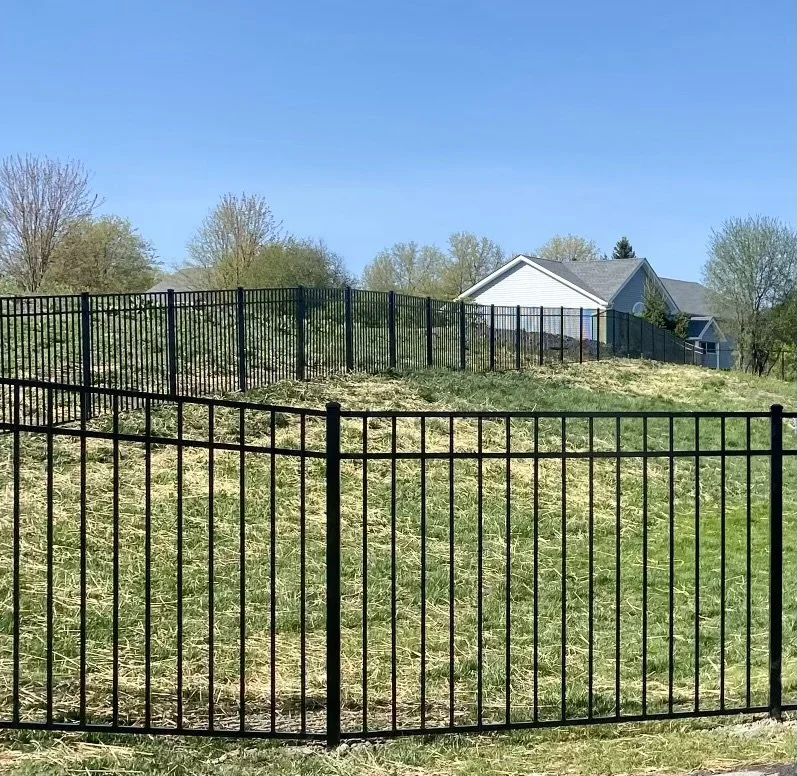
Aluminum fence panels are a real advantage over a preassembled vinyl or wood section on a sloped yard. Most residential aluminum panels use swivel brackets or routed rail holes that let the section rack, meaning the rails tilt to match the ground while the pickets stay plumb. A racking panel follows a gentle grade without leaving a gap under the bottom rail and without cutting. Ask for the racking capacity in inches per section, because it varies by style.
Steeper ground calls for stepping. Stepped installation keeps each panel level and drops the next one a fixed increment, leaving triangular gaps at the bottom that you fill with grade or a kick panel. Yards along the Pompton River sit on uneven ground, so walk your line with a level first.
Does the Coating on Aluminum Fence Panels Fade or Chip?
A properly applied powder coat does not chip or peel the way liquid paint does, because the finish is electrostatically bonded and cured onto the metal rather than brushed on top of it.
Our aluminum carries a super durableTGIC powder coating, and the written warranty states it will not peel, crack, chip or blister for as long as you own the fence. That is a material promise, and it is why aluminum outlasts painted steel in a wet climate.
Maintenance is close to nothing: rinse the panels once a year with a hose and mild soap, more often near salt water or a heavily treated road. Do not use solvents on a coated surface, because they soften the polymer matrix and void the coverage.
Black, bronze and white move fastest through our lot, and darker colors recede so a black run reads as almost transparent across a lawn.
What Gate Hardware Should You Order With Aluminum Fence Panels?
Hardware is where a careful order goes wrong most often, because people size the panels and then grab whatever hinge is in the bin.
Order self-closing hinges for any gate in a pool barrier, since New Jersey barrier code requires the gate to swing outward and close on its own. Pair them with a self latching latch on the inside face at the required height. A magnetic latch holds alignment better than a mechanical hook.
For garden and driveway gates the choices open up: standard butt hinges with a drop rod, a lockable latch on anything facing the street, and a gate stop on every double drive gate so the leaves do not swing past center. Each piece is a separate line item, so build the hardware list at the same time you build the panel list.
Railings Are a Separate Order
People often assume an aluminum fence panel and an aluminum railing are interchangeable. They are not. Railings are engineered for a deck, a porch or a set of stairs, and they meet load and height requirements a fence panel does not address.
Related: 7 Aluminum Fence Designs to Elevate Your Monmouth County, NJ Backyard Event
What Northern New Jersey Weather Does to an Aluminum Order
Our corner of the state throws four real seasons at a fence line. Freeze and thaw cycles work on footings all winter, which makes footing depth the most important field decision on the job. Road salt spray reaches any fence within about 20 feet of a treated road, arguing for stainless fasteners and a darker coating that hides residue. Heavy August storms load the panels sideways, which is where the third rail on taller sections earns its cost.
Soil across Pequannock and the surrounding townships runs heavy with clay in places and loose with river sediment in others. Clay holds water against a footing and freezes hard, so gravel at the bottom of each hole is not optional here. Sandy river soil drains well but offers less lateral grip, so gate posts near the water get a wider footing.
Deer pressure in Morris County changes what people order alongside aluminum. An open picket panel does nothing to keep deer out of a garden, so many customers run aluminum where the yard is visible and switch to vinyl privacy panels or chain link where it is not. Mixing materials by zone is normal and we price each zone separately.

How to Measure and Place an Order at Our Pequannock Counter
Start with a sketch of the property drawn roughly to scale, marking the house, driveway, patio and any pool. Walk the fence line with a long tape and record each straight run in feet, corner to corner. Mark every gate opening and its swing direction. Record each run as flat, gentle or steep, because that decides racking or stepping.
Bring the sketch to our Pequannock design center with photos of the yard and any deed survey. Our counter staff converts the runs into panel counts, post types, hardware and concrete, then prices it as one materials list. You leave knowing what is in the order and what it costs.
Material pickup runs Monday through Friday from our yard, with seasonal Saturday hours, and phone orders are taken during showroom hours at 1-833-MYFENCE. Contractors scheduling a job site load coordinate in advance so panels, posts, hardware and concrete go out together. Orders also go in online with the details finished at the counter.
What to Check Before You Dig
Call 811 for a utility mark out before any post hole gets dug. Confirm township permit rules on height and setback, because Pequannock and its neighbors do not all read the same. Verify your property line against the survey rather than the neighbor's old fence.
Why Buying Aluminum From a Dedicated Supply Team Pays Off
A big box store sells you a panel. A supply house sells you a fence that adds up. The difference shows at the counter, where somebody who has sized thousands of yards asks about slope, gate swing, frost depth and post type before printing a list. That prevents the return trip for the piece nobody counted.
Because our aluminum line is manufactured under our own name, replacement parts stay consistent for years, so a picket damaged by a fallen limb in year eight gets matched rather than approximated. Stock depth also means a contractor calling Tuesday for a Wednesday load usually gets it, which is why so much volume goes to trade customers across Morris, Passaic, Bergen and Essex County.
We carry the rest of the yard too, so customers ordering aluminum for the front and a solid screen for the back get both on one list, one invoice and one pickup. That is the value of a full fence supply in Pequannock rather than a single product line.
Order Your Aluminum Fence Panels in Pequannock, NJ
Bring your measurements and a sketch to our Route 23 design center and walk out with a complete materials list for your aluminum fence panels, posts, gate hardware and concrete.
We size orders for homeowners doing the work themselves and for contractors buying by the job, and we stock the aluminum railing line for decks and stairs alongside it.
Call the showroom or talk to our counter team about a pickup window that fits your schedule. MyFence2Go supplies the aluminum fence panels, posts and hardware; you supply the Saturday.
In Summary: Quick Answers on Aluminum Fence Panels
How wide and how tall are aluminum fence panels?
Residential panels come in six foot and eight foot widths, in heights of 36, 48, 54, 60 and 72 inches, covering nearly every yard condition from a decorative front boundary to full back yard screening. Height follows the job: shorter panels keep sightlines open, while 54 inches is the common minimum around a pool under most New Jersey municipal codes.
How deep do the posts need to go?
Posts are typically set 30 to 36 inches deep in concrete, below the frost line for Morris and Passaic counties, which runs well past two feet in a hard winter. A footing set shallower than that heaves with the frost, racks the panel out of square, and stops a gate from latching by the second spring.
Will aluminum panels follow a sloped yard?
Most residential panels rack to a gentle grade through swivel brackets or routed rail holes, letting the rails tilt while the pickets stay plumb and without leaving a gap under the bottom rail. Steeper ground calls for stepped installation instead, dropping each level panel a fixed increment and filling the resulting gaps with grade or a kick panel.
What hardware does a pool gate need?
New Jersey barrier code requires a self closing hinge that swings the gate outward and closes it automatically, paired with a self latching latch mounted on the inside face at the required height. A magnetic latch holds alignment more reliably than a mechanical hook, which matters since this hardware carries a legal requirement, not just a convenience.
What's the difference between residential and commercial grade aluminum?
Grade refers to wall thickness and rail size, with residential grade sized for a typical back yard boundary or pool barrier and commercial grade stepping up rail dimensions for schoolyards, apartment complexes, and other high-traffic sites. A typical Morris or Passaic County home only needs residential grade, since commercial extrusions add cost without adding useful life on a private lot.
Related: Modern Aluminum Backyard Fence Designs in Westchester County, NY: Durable and Stylish Solutions
